There was an anecdote1 about vanilla WoW development that Blizzard spent a month on polishing the Fireball ability: most of the gameplay is killing simple mobs such as wolves for some experience, money or items. For a mage to kill wolves, they have to throw fireball many times. Throwing fireball is the simplest element of the gameplay, and it's essential to make it fun. The simplest part of the gameplay must be satisfying and as polished as it can be. This ethos applies to all the good games: the jumping in Super Mario is fun; the shooting in Counter Strike is fun; the moving in Apex Legends is fun. Attacking is often the most essential part of the gameplay for a non-cozy game, including, naturally, soul-likes, a rising sub-genre in past decade, which is all about exploring the world and killing bosses standing in the way. There was one title, however, from the very developer who introduced the soul-like sub-genre, that instead of attacking, the game was designed and built around another mechanic: the parrying–Sekiro: Shadows Die Twice.
Souls-like bosses are intimidating, they kill the player dozens of times before their demise; one hit is fatal and a single mistake leads to a "You Died" screen. Since melee combat in a soul-like is all about timing and spacing, when the player hasn't being familiar with the boss's pattern to find the timing, they tend to run for more space. From Software spent a lot of time and content to teach the player to fight this instinct, often with severe punishment against running away from the boss: in Dark Soul, the Bell Gargoyles turns into a gank2 encounter in the second part of fight, as well as being more aggressive when the player is away; the Capra Demon is also a gank encounter on the top of being in a extremely narrow room, practically eliminating the possibility of hit-and-run strategy. Both of them are, unless the player is familiar with the game's geography, in the very early phase of the game, as if Hidetaka Miyazaki, the father of soul-likes, was telling the player to learn to play the game (or, in urban vocabulary, "git gud") or quit in frustration.
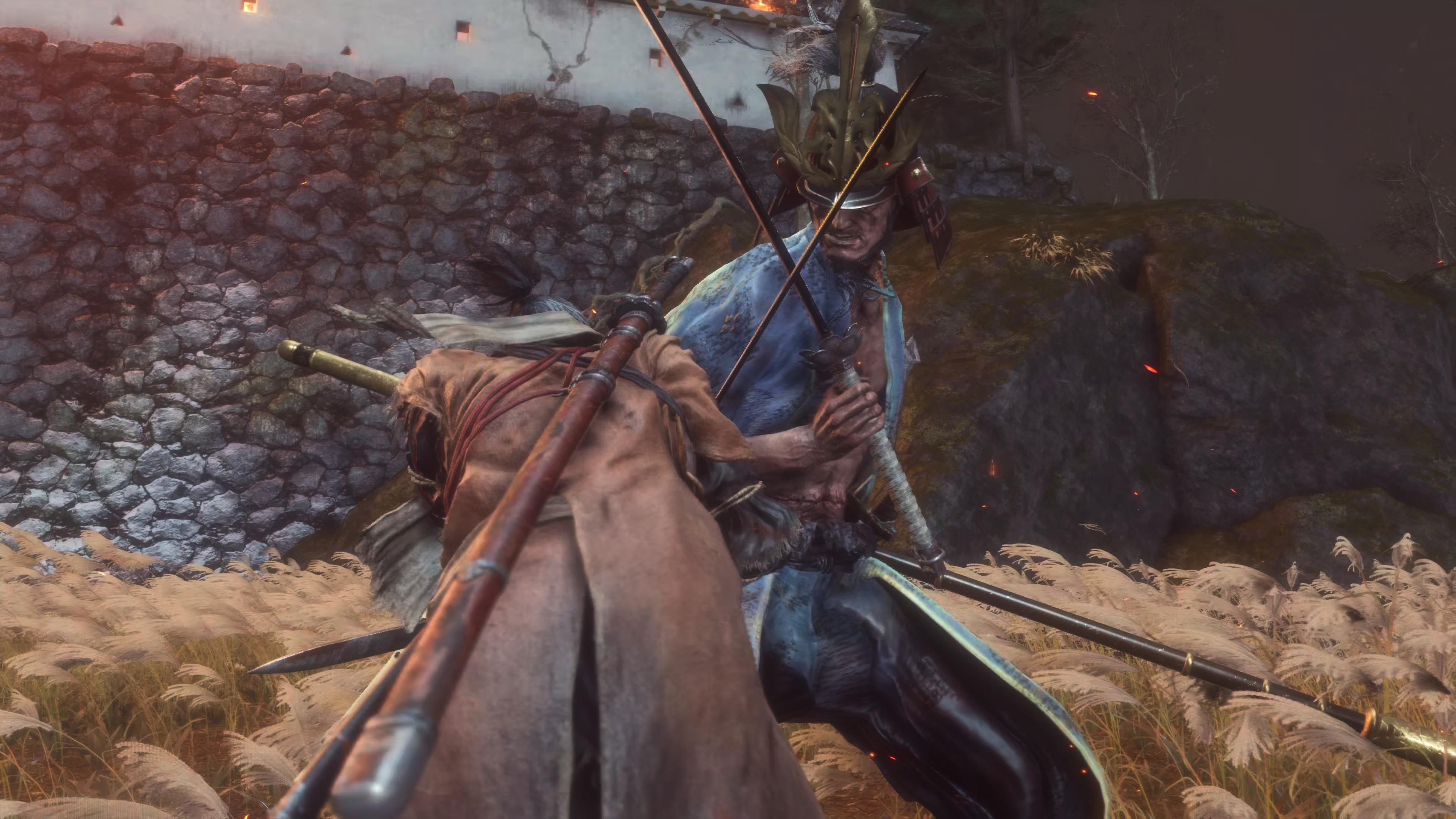
Parrying completely changed this dynamic. An enemy is dead when either having zero health or full posture, and by design, the latter, which is filled up when the player parries the enemy’s attack, and vice versa, happens way more common. A defensive maneuver thus becomes the most effective offensive option, therefore properly learning the enemy's attack pattern and precisely parrying them becomes the obvious path to victory. The combat is no longer the player finding the window to sneak in a hit or two to chip away the boss's health bar, but two equal opponents teasing, attempting and countering each other's strikes. Swords collide as sparks fly and crisp clang rings. The player reads the next four attacks and parries them all. They strike after. They stop after three hits because they know the enemy is going to counter at the fourth one. They parry that as well. Both party take no damage after the sequence; it's still a long way until the fight's end, but it's no matter. The fun is in the fight. Each perfectly timed parrying is a positive stimulation as well as a proof that the player understands the encounter. From Software provided, in its soul-like titles including Sekiro, many boss fight "escape hatches" through items, secondary weapons or stage-specific gimmicks to make them more approachable, but some players prefer to fight the bosses with nothing but the most basic tools i.e. weapon attack and evasive maneuver. I'm in this group as well. Nothing against that way to play the game, it's just the process of reading move patterns, making strategy and pursuing the perfect execution is, to me, the reason to play soul-likes in the first place, and in Sekiro, these fast-paced conversation with the enemy–the back and forth, read and react in milliseconds–through nothing but swords colliding is where this game shines the best. Below are my favorite encounters in the game:
5. Guardian Ape (獅子猿)
The most iconic boss encounter in the game. Maybe even in all From soul-likes. The kill–the most brutal execution in the game–the Shinobi Execution announcement, then while the player is still enjoying the victory, the body starts moving. Unforgiving phase two is a common phenomenon in From soul-likes, but leveraging the meta-game kill announcement along with the player's confusion as narrative tools is simply astonishing.
4. Isshin, the Sword Saint (剣聖 葦名一心)
The final boss in three of the four endings, and the difficulty reflects it. The rhythm change among the sword, the spear, and the Glock in phase two used to give me trouble, now they work as nice accents in the fight.
3. Inner Genichiro (心中の弦一郎)
Genichiro fights the player many times in the game, but as he serves as a tutorial role, all of the encounters are, while nicely paced, a bit bland, except the inner one. I love the additional Sakura Dance (桜舞い) move for its block damage forces the player to perfectly parry them, but when properly performed it's a satisfying interaction. The double Lightning Reversal (雷返し) in phase three sets an epic finale tone as well.
2. Corrupted Monk (宮の破戒僧)
Best boss fight soundtrack in the game. One of the most parry-heavy fight, which is my favorite kind of fight. The phase two illusions are a bit lame but thank god and Miyazaki it can be legally skipped. I struggled a bit on the phase three forehand quick hit, usually after the terror spewing. Once I got used to that the whole fight became a smooth and satisfying parrying streak.
Honorable mentions
Lady Butterfly (まぼろしお蝶)
やるじゃないか、せがれ殿 Impressive, boy.
Badass phase two transition. I'm not too fond of the illusion tricks though. The most beautifully choreographed fight in the game, feels like a dance. Also the first boss to enlighten me about the beauty of parrying, only wish it was longer or if there was an inner version.
Inner Father (心中の義父)
Both the aggressiveness and many move variations are enjoyable, but in phase two he pulls out a Hedwig Patronus and Fawkes which badly kills the flow.
Isshin Ashina (葦名一心)
A big rhythm difference from the Sword Saint, which is fun, but phase two fire tricks are not my thing. A nice match with the Shura ending nonetheless, I guess.
1. Inner Isshin (心中の一心)
Yes, Isshin fight is so good that he is in top five twice. Being even more aggressive with new moves, the enhanced Sword Saint Isshin is arguably the most difficult, and to me, the most fun fight in the game. I especially like the new perilous attack which turns into a three parrying combo. Not bragging, I parried the second hit in air in my first try, because at that moment I had immersed my body in the rhythm of the fight, and parrying at the very moment was just a natural response. Nothing but great game design.
I first played this game in 2022, spending about two weeks to barely beat the game i.e. Immortal Severance ending, no Headlesses or Shichimens, no side quests, etc. At the time Demon of Hatred and Isshin both took me more than four hours. I never beat Inner Genichiro or any Gauntlets of Strength. At the start of this replay I spent about an hour on Isshin. After four rounds of new game plus, I recorded some footages for this review and found myself beating Inner Isshin and Genichiro without HUD in one try. In the game the player gets a Memory ("戦いの記憶") after defeating a boss, which can be consumed to increase attack power. In other words, Sekiro becomes stronger after each combat against an extraordinary foe. The narrative and gameplay perfectly blends here, as the same happens to the player as well. I've lost count how many times I've fought Isshin. Sometimes at the end of a day's run, before sleep, I would do a couple of quick fight with Isshin or Genichiro, not for checking boxes, farming or even practicing, only because it's fun, satisfying and rewarding. It's my first, and likely my last, full achievement game. I have yet achieve no-hit against the inner bosses so I may keep fighting them; after no-hit I may try high-risk stylish fight, the kind people do on YouTube; I may keep playing after that, because parrying is fun.
- 1https://xelnath.com/2012/06/30/the-simplest-thing-first/. I spent a lot of effort (and tokens) to search the source of this anecdote, including reading a full book. I’ll leave it to another story.
- 2In gaming community, gank means multiple versus one assault. In soul-likes specifically, gank boss means the encounter contains more than one enemies. I hate them so much.